
FROM
SPARK
TO
SOUL
Wolfgang Amadeus Mozart (1756–1791)
Overture to The Abduction from the Seraglio, K. 384
Mozart composed The Abduction from the Seraglio in 1781–82, shortly after establishing himself as a freelance composer in Vienna. Premiered in 1782, the opera became an important success and helped establish Mozart’s reputation as a composer for the Viennese stage.
The overture immediately transports us into a world of theatrical excitement. Its brilliant, energetic opening is punctuated by the distinctive sounds of eighteenth-century “Turkish” or Janissary music, including percussion such as triangle, cymbals and bass drum. A more lyrical and reflective central section provides a moment of contrast before the sparkling energy returns.
Fun fact: Mozart himself described the overture to his father as music so lively that he doubted anyone could fall asleep during it—even after a sleepless night!
Listen for the vivid contrasts between loud and soft, the infectious rhythmic energy, and the colourful percussion that gives this short overture its irresistible sense of celebration and anticipation.
Felix Mendelssohn (1809–1847)
String Symphony No. 8 in D major
Felix Mendelssohn was just thirteen years old when he completed his String Symphony No. 8 in 1822. Yet there is nothing small-scale about this remarkable work. It is one of his most ambitious early compositions, conceived on a symphonic scale and lasting around half an hour. Mendelssohn valued the work highly enough to create a second version for full orchestra shortly after completing the original for strings.
The symphony reflects the young Mendelssohn’s deep study of the great composers who came before him. A dramatic slow introduction leads into an energetic Allegro, while the expressive Adagio reveals a surprising depth of feeling for such a young composer. A graceful Menuetto follows before the work races towards an exhilarating finale of remarkable contrapuntal complexity.
Fun fact: Mendelssohn wrote thirteen String Symphonies between the ages of twelve and fourteen. No. 8 was so ambitious that he soon expanded it from a work for string orchestra into one for full symphony orchestra.
Listen especially to the dialogue between Classical elegance and Baroque-inspired counterpoint. In the finale, the young Mendelssohn displays an astonishing command of musical architecture, weaving multiple lines together with the confidence and energy of a far more experienced composer.
Johannes Brahms (1833–1897)
Double Concerto in A minor for Violin, Cello and Orchestra, Op. 102
Brahms composed his Double Concerto in 1887, and it would become his final work for orchestra. Written for violinist Joseph Joachim and cellist Robert Hausmann, the concerto brings two solo instruments together in one of the most remarkable musical dialogues of the Romantic repertoire.
The work also has a deeply personal history. Brahms and Joachim had been close friends for decades, but their relationship was damaged following Joachim’s divorce. The Double Concerto is often regarded as a gesture of reconciliation between the two friends, with music becoming a means of reopening a conversation where words had perhaps failed.
The concerto opens dramatically before the cello steps forward with an extended and searching statement, soon joined by the violin. Rather than simply competing for attention, the two soloists constantly listen, respond and intertwine. The lyrical slow movement offers one of the work's most tender moments, while the energetic finale brings virtuosity, rhythmic vitality and a sense of joyful release.
Fun fact: Brahms and Joachim had been friends for more than thirty years, and the concerto was written partly in the hope of restoring their damaged relationship. Clara Schumann described it as a “work of reconciliation.”
Listen for the conversation between the violin and cello. Sometimes they appear as two distinct personalities; at other moments, their voices merge so completely that they seem to become one. In this extraordinary work, Brahms transforms the concerto into something more intimate: a conversation about friendship, conflict, understanding and, ultimately, reconciliation.
Music Director
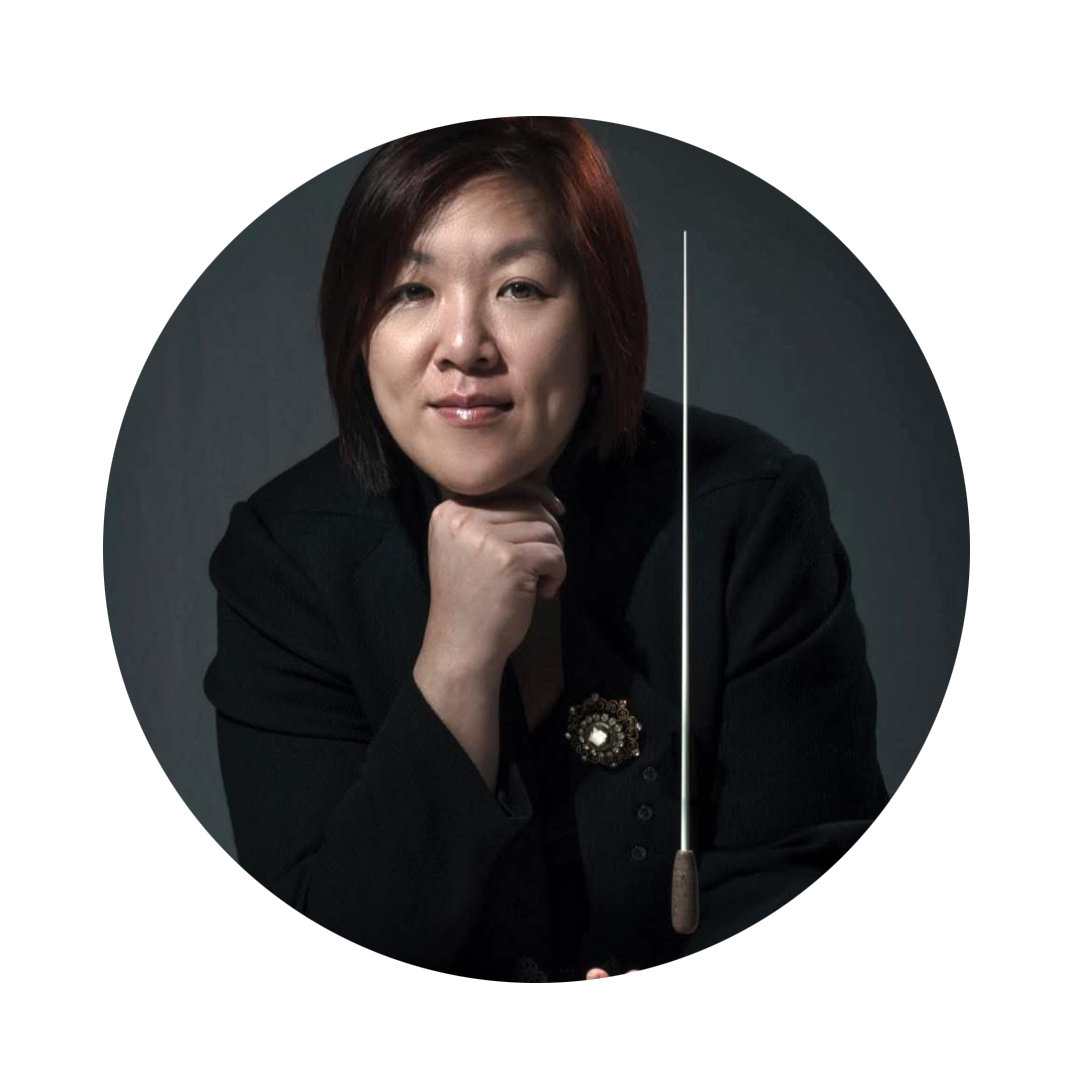
Elizabeth Lau (Conductor)
Elizabeth Lau is the Founder and Creative Director of Wairua Sinfonietta, a non-profit orchestra that unites emerging and professional musicians to perform in support of charitable causes worldwide. In 2024, she also founded the Wairua Youth Sinfonietta, dedicated to nurturing the next generation of orchestral players and fostering meaningful musical opportunities for young musicians.
A graduate of the University of Auckland, Elizabeth was the first to complete a Master of Music in both Choral Conducting and Orchestral Conducting, alongside studies in composition, collaborative piano, and double bass. Her mentors include Dr Rae de Lisle, Honorary Associate Professor Dr Karen Grylls ONZM, Emeritus Professor Uwe Grodd, and the late Maestro Eliano Mattiozzi Petralia.
Elizabeth has conducted internationally and worked with ensembles including Auckland Philharmonia, Manukau Symphony Orchestra, Piper Sinfonia, Mozart Orchestra, Auckland Choral, and Bach Musica. She currently serves on the advisory team for the New Zealand Children’s Choral Academy, contributing to the development and support of young choral singers across the country. She is recognised for her thoughtful musical leadership, collaborative approach, and commitment to building inclusive artistic communities.
Career highlights include serving as Assistant Conductor for the world premiere of LEN LYE: The Opera (2012) by Eve de Castro-Robinson, and participating in the 2021 world premiere of Ihitai ‘Avei’a – Star Navigator, an opera co-composed by Tim Finn and Tom McLeod. In 2026, she conducted the inaugural Chinese New Year Symphony Concert at the Auckland Town Hall, marking a significant milestone in cross-cultural musical celebration.
Through Wairua Sinfonietta, Elizabeth combines artistic leadership with community impact, presenting concerts that inspire audiences while supporting meaningful charitable initiatives. Outside of music, Elizabeth is passionate about cultural exploration, visiting art galleries, and creative expression through painting and photography.
Soloists
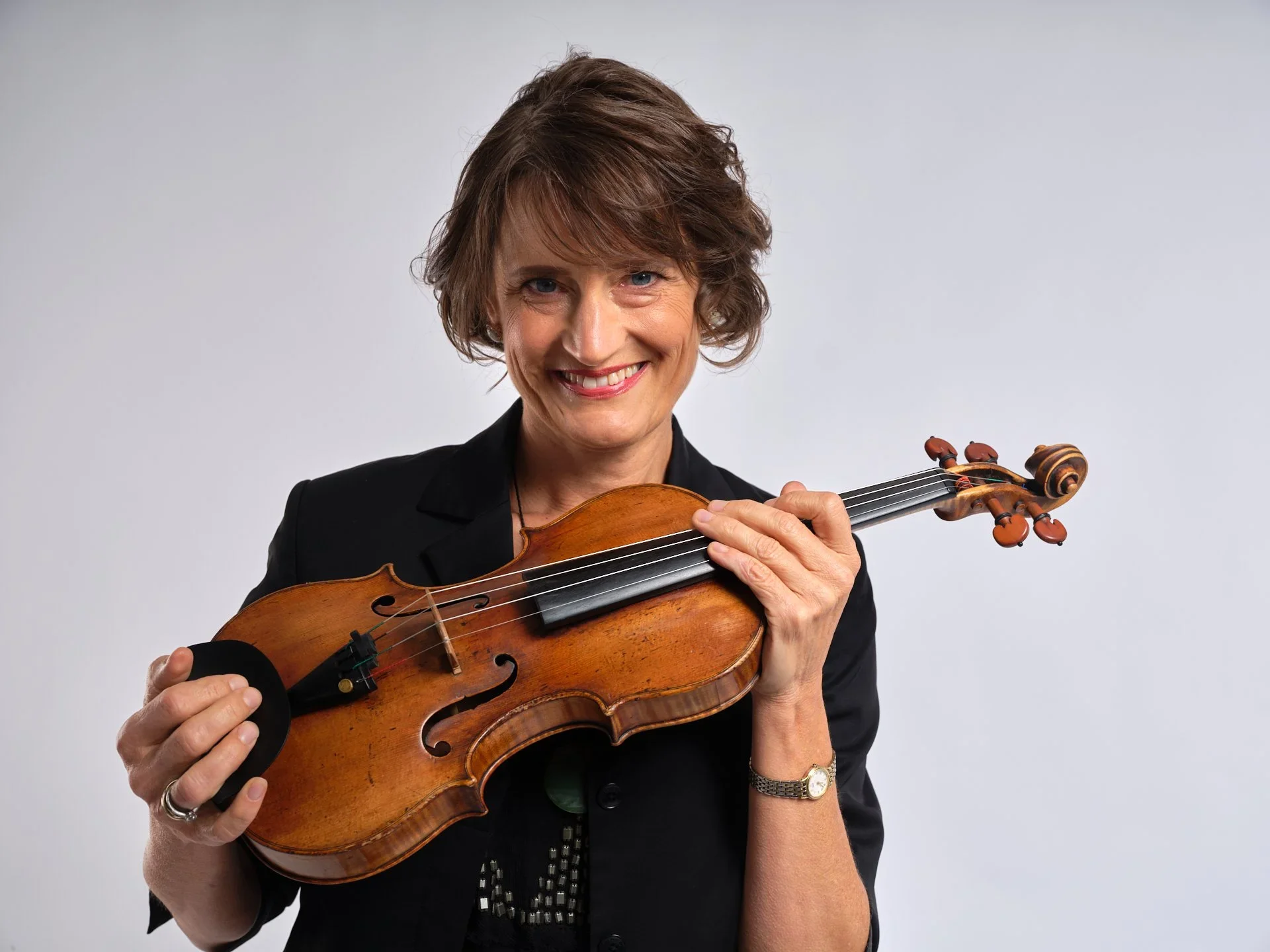
Helene Pohl (Violin)
Violinist of the piano trio Korimako and teacher at the Wellington String Academy, Helene Pohl was born in Ithaca, New York to German parents and spent her childhood on both sides of the Atlantic. She began learning violin at age 4 with the Suzuki Method, also had lessons in piano, guitar and clarinet and played baritone saxophone in her high school jazz band. She studied at the Cologne Hochschule, the Eastman School of Music, and Indiana University, where her teacher was the legendary Josef Gingold. From 1988-93 she was first violinist of the San Francisco-based Fidelio Quartet. She then spent 30 years as first violinist of the New Zealand String Quartet. She has played many concertos around New Zealand, including the world premiere of Louise Webster’s concerto In Hollowed Bone I Hear the Seas Roar which was written for her. From 2001- 2025 she was Co-Artistic Director of the Adam Chamber Music Festival. With the NZSQ, she founded and taught at 31 Adam Chamber Music Summer Schools. Her violin students from 3 decades of teaching at Victoria University are members of the NZSO, Orchestra Wellington, and the Christchurch Symphony, play chamber music, teach, conduct, compose and add value to New Zealand’s cultural life in myriad ways. Equally committed to nurturing younger students, Helene is Patron of Arohanui Strings+, teaches at youth music camps and workshops, and founded the Queen’s Birthday Chamber Music Weekend (now the Chamber Music Mega Weekend) in 2014. Helene is a Thomastik-Infeld artist and proudly plays Thomastik-Infeld strings.
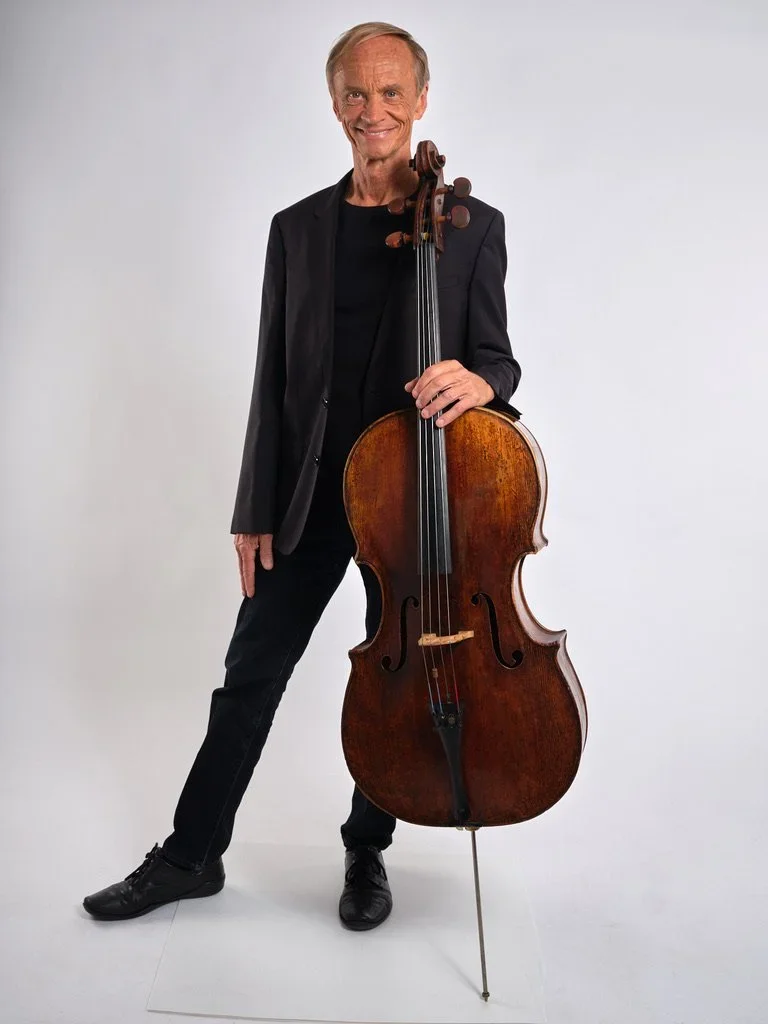
Rolf Gjelsten (Cello)
Rolf Gjelsten grew up in Victoria, Canada, in a Norwegian family of folk dancers. In his teens, he became an accomplished accordionist before focussing on cello studies with James Hunter and Janos Starker. In 1975, he was awarded the silver medal in the Canadian National Music Festival. At 22 he joined the Berlin Symphony Orchestra in Germany. Rolf then furthered his cello studies with Zara Nelsova and chamber music with such eminent groups as the LaSalle, Hungarian, Vermeer, Cleveland and Emerson string quartets. He was a regular participant in both the Banff School of Fine Arts and the Aspen Music Festival. His Vermilion String Quartet won Ensemble of the Year from Downbeat Magazine while studying with the Vermeer Quartet.
As a member of the Laurentian Quartet for almost a decade he toured internationally as well as teaching cello at Sarah Lawrence College in New York. During this time he was also a member of the New York Piano Trio, as well as playing regularly with organ legend Anthony Newman and the Collegium Musicum of New York. He was invited to the Bach Aria Festival in New York and the Prussia Cove International Musicians' Seminar a number of times. In 1990 he continued studies with the great Casals protégé Bernard Greenhouse at Rutgers University from where he received his doctoral degree. He has given masterclasses all over the world, including at Peabody Conservatory, Rice University, Banff School of Fine Arts, and Stuttgart Hochschule für Musik.
Rolf has performed with such eminent artists as Menahem Pressler, Anton Kuerti, Piers Lane, Kathryn Stott, Franco Gulli, Zoltan Szekely, Nobuko Imai, Frans Helmerson, Colin Carr, James Campbell, Gervaise de Peyer, and members of the Hungarian, Tokyo, Vermeer, Prazak. Takacs and Jerusalem String Quartets. He has enjoyed playing with the New Zealand String Quartet from 1994 to 2024, touring at home and abroad, making recordings, teaching at NZSM and giving masterclasses. In 2015, Rolf premiered and recorded Gareth Farr’s “Dear Horizon” cello concerto with the RNZB and the NZ Army Band. He became a New Zealand citizen in 1997 and was made a member of the NZ Order of Merit for services to music in 2014.
Musicians
Violin 1
Harris Leung**
Michael Sun
Emily Wilby
Danny Chou
Synthia Zhou
Nancy Chen
Violin 2
Olga Komenko*
Martin Qiang
Skyla MacDonald
Skylarr Orr
Louise Gaste
Viola
Mei Fong Edgar*
Amanda Lawrence
Dora Tsao
Cello
Natarani Witten-Hannah*
Samantha Berrington
Zoe Li
Xilong Zhang
Bass
Fei Yang Wu
Flutes
Annie Hong*
Edwin Yu
Oboes
Joy Liu*
Vanessa Newton-Wade
Clarinets
Le Chang*
Song-Yi Choi
Bassoon
Ben Pollard*
Trumpets
Stephen Bemelman*
Jeremy Strang
Horns
Yih-Hsin Huang*
Tony Webster
Timpani
Mary Lewis*
Special Thanks
This concert would not have been possible without the generosity, care, and dedication of our wonderful volunteers—musicians, on-site teams, and behind-the-scenes supporters alike. Each of you has helped shape an evening that we hope will linger warmly in the memory of our performers and audience.
Our heartfelt thanks to:
St Matthew-in-the-City Event Manager – Dmitry Rusakov and staff
St Matthew-in-the-City - Event Manager Dmitry Rusakov and staff
Front of House Assistants - Cheryl Hui, Kitty Ling, Tracy Ma, Josephine Yim
Website and Poster Design - Sarah Healey Design
Photographer - Thomas Hou
Catering - Kitty Ling
Publicity - Elizabeth Lau, Tracy Ma
Flowers - Margaret Sek
Your time, energy, and kindness have woven together every thread of this concert. We are deeply grateful.
This music is as much yours as it is ours. Thank you for being part of our journey.